
Synaptik CMS Performance
Synaptik CMS is optimized to be fast, no matter what. The result is consistent, predictable performance regardless of how much content you publish — with a total CMS footprint ~2 MB and zero runtime dependencies beyond PHP 8.0.
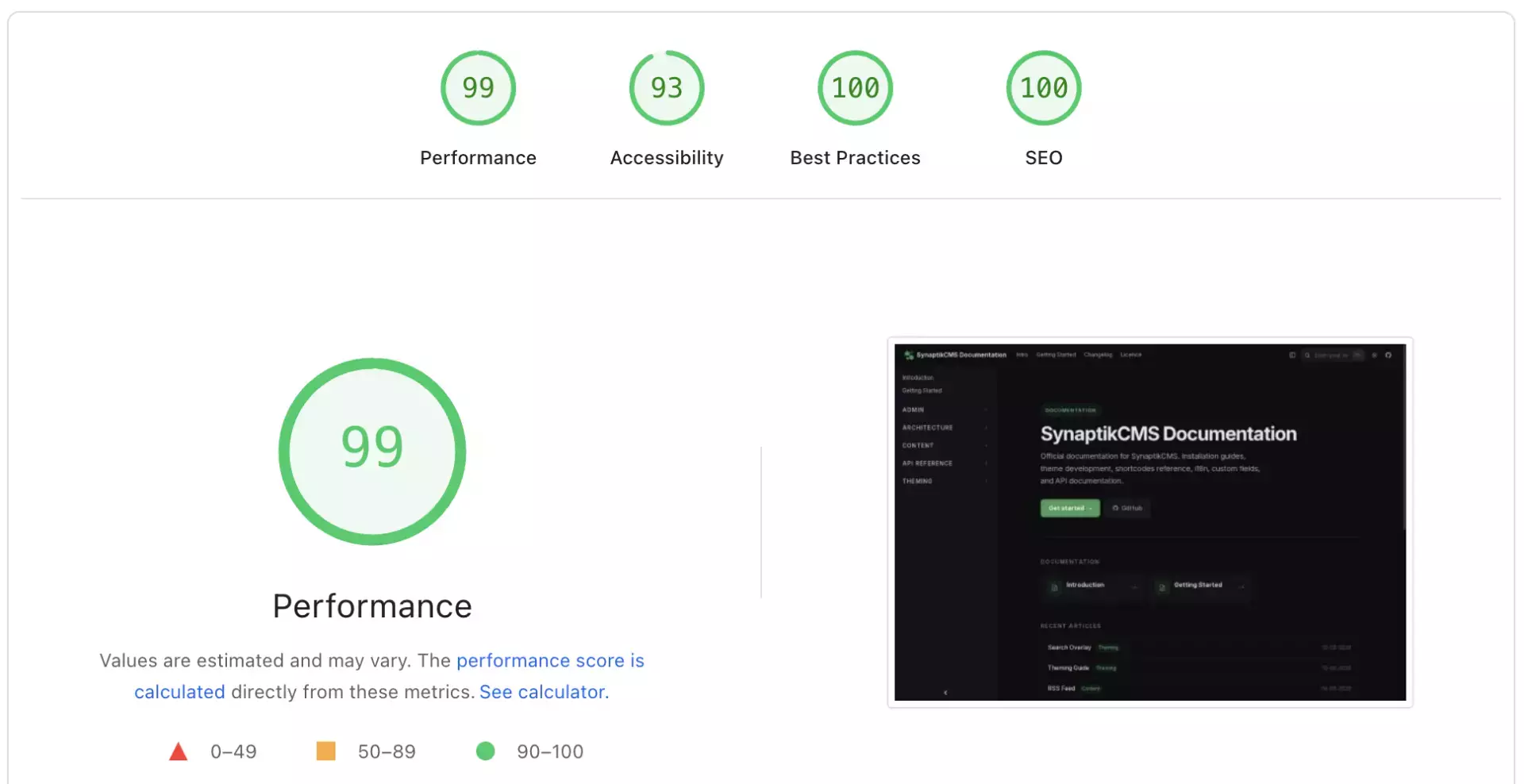
Since numbers speak for themselves, here is an example of this site's performance measured with Google PageSpeed Insights on the homepage, with no caching plugin, no CDN, and no server-side optimization beyond standard PHP and Apache.
PageSpeed Insights Test - Main Synaptik Site

The same test on the documentation website, also powered by Synaptik CMS proves how efficient this CMS really is.
PageSpeed Insights Test - Synaptik Documentation Site
How does it work?
Architecture
The CMS architecture is built around one principle: only load what the current page actually needs. Content is stored in lightweight JSON files — a split-file structure where each item lives in its own file, and a separate lightweight index holds just the metadata needed for listings. When a visitor opens a single article, Synaptik CMS reads exactly two files: the index entry and the item itself. Nothing more.
This means a site with 500 articles loads just as fast as one with 5. There's no query planner, no connection pool, no ORM overhead — just direct file reads, served by PHP at full speed. On top of that, content indexes are cached in memory across the request lifecycle and persisted between requests, so repeated reads never hit the disk twice.
No moving parts, no bottlenecks
Traditional CMS platforms rely on a database for every page render — every visit triggers queries, joins, and result parsing before a single byte of HTML is produced. Synaptik CMS skips that layer entirely. There is no database server to configure, no connection to open, no query to optimize. Content is already structured, already on disk, already ready to serve.
This also means deployment is trivial. No database credentials, no migration scripts, no import/export. Move your site to a new host by copying a folder.